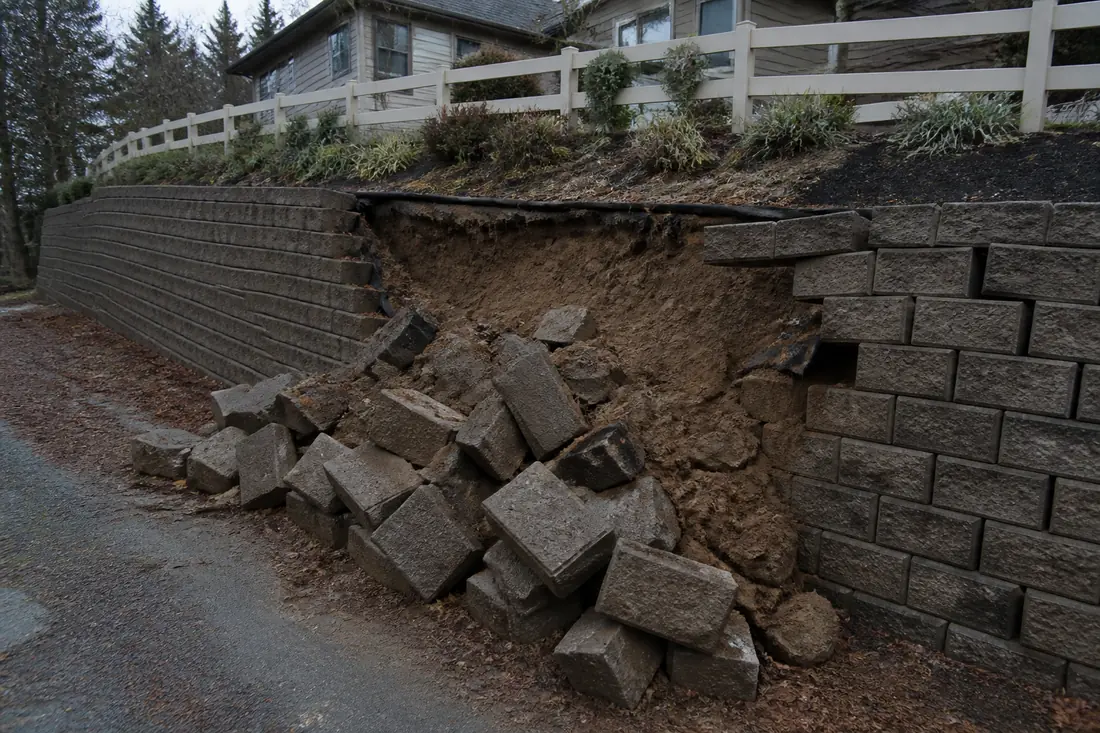
Retaining Wall Failure in Spokane Valley, WA — What to Expect
Retaining wall failure is rarely a single event. Walls move gradually, and by the time a failure is obvious the mechanism has usually been running for years. The common causes are well understood: drainage that was never installed or has stopped working, a base that was not prepared or compacted properly, reinforcement that was omitted or under-specified, a surcharge load the wall was never designed to carry, and soil movement from grading changes uphill. Poor drainage is one of the most common of these, though attributing every failure to water oversimplifies a set of problems that frequently occur together.
Identifying which applies matters more than it might appear, because the failure mode determines whether repair is viable and what a replacement has to do differently. A wall that failed for lack of reinforcement and a wall that failed because a driveway was added above it need different answers, even though both may look like the same leaning wall from the road.
The most expensive mistake in this area is rebuilding a failed wall to the same specification that failed. If the original had no drainage route and the replacement has no drainage route, the replacement is on the same trajectory from the day it is finished. Establishing why the first wall failed is not diligence for its own sake; it is what stops the second one repeating it.
What Is Included
- Failure mode identified before a replacement is designed
- Drainage, base, reinforcement, surcharge and soil movement all considered
- Existing wall assessed for what can be salvaged
- Replacement specified to correct the original cause
- Written findings with the reasoning stated
- Honest view on repair versus rebuild
The Retaining Wall Failure Process
- 1
Step 1: Establish the Failure Mode
Drainage, base preparation, reinforcement, surcharge and soil movement are each considered against what the wall is actually doing. Several often apply together, and naming only the obvious one leads to an incomplete fix.
- 2
Step 2: Assess What Remains
How much of the wall is sound, whether the base can be reused, and whether the failure is confined to one span. Salvageable sections reduce the scope and the cost.
- 3
Step 3: Specify the Correction
The replacement is specified to address what went wrong, whether that is a drainage route the original never had, reinforcement it lacked, or a base that was never adequate for the load.
- 4
Step 4: Put It in Writing
Wall type, base depth, drainage detail, reinforcement layout and backfill specification, written down so it can be compared against other bids on the same terms.
Types of Retaining Wall Failure in Spokane Valley
Drainage Failure
Walls that failed because water behind the face had no route out, or because the route silted up over time.
Reinforcement Failure
Walls built without geogrid or with insufficient reinforcement for their height, surcharge or geometry.
Base and Bearing Failure
Walls that moved at the bottom because the base was shallow, uncompacted or built on unsuitable material.
Surcharge-Driven Failure
Walls carrying loads added after construction — a driveway, parking area or structure the original design never accounted for.
What Matters When Choosing a Retaining Walls Contractor in Spokane Valley, WA
Drainage designed in, not added on
Poor drainage is one of the most common causes of retaining wall problems in this region. Drainage stone, filter fabric and outlets are part of the design, never an upsell.
We tell you when you need an engineer
Spokane Valley requires an engineered design for walls four feet or higher measured from the bottom of the footing — not from the exposed face — and underdrains on the same basis. Surcharged and tiered walls bring it on sooner. Worth establishing before a design is paid for rather than at plan review.
Built for freeze-thaw
Inland Northwest winters move soil hard. Base depth, compaction and backfill are specified for frost, not copied from a warm-climate detail.
Written scope before work starts
Wall height, block type, drainage detail, geogrid layout and backfill material, all in writing. You can put it out to competitive bid.
Slope and erosion work, not just walls
Sometimes the right answer is regrading, terracing or planting rather than a taller wall. We will tell you when that is cheaper.
Clean sites, real restoration
Excavation spoil hauled away, access routes protected, and the lawn put back. Wall work is heavy and messy — the cleanup is part of the job.
Retaining Wall Failure FAQs
Why do retaining walls fail?
Most often some combination of drainage that was absent or has stopped working, a base that was not properly prepared, reinforcement that was omitted, a surcharge load the wall was not designed for, and soil movement from changes uphill. Poor drainage is one of the most common causes, though failures frequently involve more than one of these at once.
How long does a retaining wall last before it fails?
Service life depends on the material, the drainage, the soil, the quality of installation, exposure and loading rather than on a fixed number of years. A well drained and properly reinforced masonry wall can last decades. A wall with no drainage route can start moving within a few seasons regardless of what it is built from.
Can a failed retaining wall be repaired?
Sometimes, particularly where the failure is confined to one span and the base is sound. Where the wall has moved substantially, lost bearing, or failed along its full length, replacement is usually the honest answer. What determines it is the failure mode rather than the appearance.
What happens if we just rebuild it the same way?
It tends to fail the same way. If the original had no drainage route and the rebuild has none either, the replacement starts on the same trajectory from the day it is completed. Establishing the original cause is what stops that repeating.
Is a failed wall a hazard?
It can be, depending on height, what it retains and what sits below it. A wall above a path, driveway, neighboring property or anywhere people pass warrants prompt assessment. A low garden wall that has slumped is a different order of problem.
Other Services in Spokane Valley
- Poured Concrete Retaining WallsCast-in-place reinforced concrete for high walls, tight property lines and heavy surcharge loads.
- Retaining Wall DrainageDrainage design and retrofit — relieving the water pressure that builds up behind a wall.
- Boulder and Rock Retaining WallsNatural stone and boulder walls that suit Inland Northwest terrain and handle irregular slopes well.