Bulging and Cracked Retaining Wall Repair in Spokane Valley, WA — What to Expect
Bulging and cracking are the same conversation at different stages. A wall bows outward when pressure behind it exceeds what the wall can resist, and it cracks when that pressure exceeds what the material can carry. Both are load problems rather than surface problems, which is why filling a crack rarely settles anything: the filler hides the symptom while the mechanism carries on.
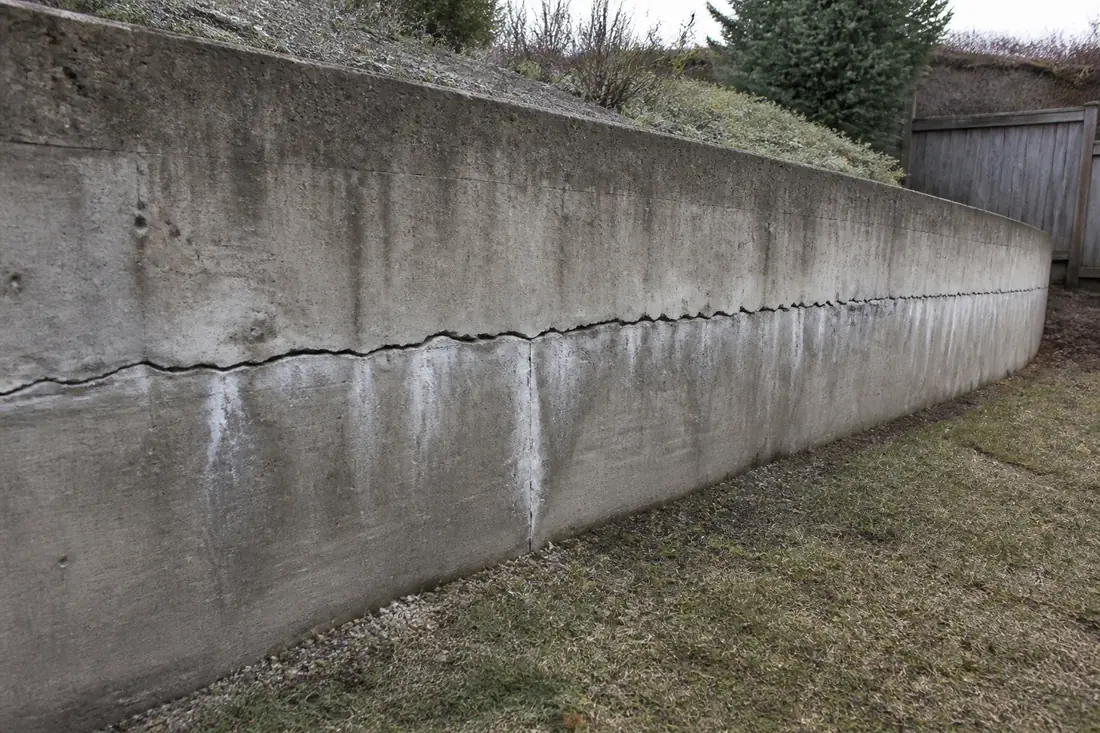
The crack pattern is informative. Vertical cracks at regular intervals in a poured concrete wall often relate to shrinkage or to control joints that were placed badly, and may not indicate structural trouble. Diagonal cracking running from a corner, or a horizontal crack part way up the face, is a different matter and generally points to bending under load. On segmental block, individual blocks shearing or the joint lines going out of alignment is the equivalent signal.
Bulging in the middle of an otherwise straight wall is one of the more reliable indicators of hydrostatic pressure. Water accumulating behind the face has to go somewhere, and if the drainage stone, filter fabric and collector pipe are absent or blocked, it pushes. The bulge appears where the wall is least able to resist, which is usually the middle of the span and roughly a third of the way up.
What Is Included
- Crack pattern read for what it indicates rather than filled
- Bulge location and profile measured against the original line
- Drainage condition established behind the face
- Structural versus cosmetic cracking distinguished plainly
- Repairability assessed before any repair is priced
- Written findings suitable for a second opinion
The Bulging and Cracked Retaining Wall Repair Process
- 1
Step 1: Map the Cracking
Location, direction, width and whether the crack passes through the wall or only marks the face. Direction is the most informative single detail and is often enough to separate shrinkage from bending.
- 2
Step 2: Measure the Bulge
The face is measured against a straight line to establish how far it has moved and over what span, which sets the baseline for whether the movement continues.
- 3
Step 3: Establish the Drainage
Whether drainage stone, filter fabric and a collector pipe are present and working behind the wall. A bulge with no working drainage has a clear explanation.
- 4
Step 4: Separate Structural from Cosmetic
Some cracking is a finish issue and some is a load issue, and the two get very different answers. Which this is gets stated directly rather than hedged into a quote.
Types of Bulging and Cracked Retaining Wall Repair in Spokane Valley
Bulging Segmental Wall Repair
Block walls bowing under pressure, taken down through the affected span and rebuilt with drainage and reinforcement corrected.
Cracked Concrete Wall Assessment
Reading crack pattern in a poured wall to distinguish shrinkage from structural movement before any repair.
Drainage Retrofit Behind a Bulging Wall
Installing the drainage route that the pressure causing the bulge has never had.
Partial Rebuild of an Affected Span
Where movement is confined to part of the wall, rebuilding that span rather than the whole run.
What Matters When Choosing a Retaining Walls Contractor in Spokane Valley, WA
Drainage designed in, not added on
Poor drainage is one of the most common causes of retaining wall problems in this region. Drainage stone, filter fabric and outlets are part of the design, never an upsell.
We tell you when you need an engineer
Spokane Valley requires an engineered design for walls four feet or higher measured from the bottom of the footing — not from the exposed face — and underdrains on the same basis. Surcharged and tiered walls bring it on sooner. Worth establishing before a design is paid for rather than at plan review.
Built for freeze-thaw
Inland Northwest winters move soil hard. Base depth, compaction and backfill are specified for frost, not copied from a warm-climate detail.
Written scope before work starts
Wall height, block type, drainage detail, geogrid layout and backfill material, all in writing. You can put it out to competitive bid.
Slope and erosion work, not just walls
Sometimes the right answer is regrading, terracing or planting rather than a taller wall. We will tell you when that is cheaper.
Clean sites, real restoration
Excavation spoil hauled away, access routes protected, and the lawn put back. Wall work is heavy and messy — the cleanup is part of the job.
Bulging and Cracked Retaining Wall Repair FAQs
What does a crack in my retaining wall mean?
It depends on the direction and the wall type. Regular vertical cracks in poured concrete often relate to shrinkage or joint placement and may be cosmetic. Diagonal cracking from a corner, or a horizontal crack part way up the face, more often indicates bending under load and deserves assessment. On block walls the equivalent signal is blocks shearing or joint lines losing alignment.
Why is my retaining wall bulging in the middle?
Bulging through the middle of a span is one of the clearer indicators of water pressure behind the wall. Where drainage stone, filter fabric and a collector pipe are absent or have silted up, water accumulates and pushes, and the wall gives where it is least able to resist. Confirming the drainage condition is the first step.
Can a cracked retaining wall just be filled?
Filling addresses the appearance, not the cause. If the crack is from shrinkage in a poured wall that is not moving, that may be all that is needed. If the crack is a response to load, filling it hides the evidence while the mechanism continues, and the wall keeps moving behind the repair.
Is a bulging wall about to fall over?
Not necessarily, and not usually without further warning, but it is moving and the movement is progressive. Height, what it retains and what sits below it determine how urgent the assessment is. A tall wall above a path, driveway or neighboring property warrants prompt attention.
How much of the wall needs rebuilding?
Often less than the whole run. Where the movement is confined to one span, that span can frequently be taken down and rebuilt with the drainage and reinforcement corrected, leaving sound sections in place. That is established by assessment rather than assumed either way.
Other Services in Spokane Valley
- Concrete SealingSealing that keeps water and de-icing salt out of the slab, which is most of what decides whether concrete survives an Inland Northwest winter.
- Concrete Levelling and Slab LiftingSettled slabs raised back to level by injection, for a fraction of the cost of breaking out and repouring.
- Concrete Repair and ResurfacingCracked, spalling and scaled concrete repaired or resurfaced, starting with why it failed in the first place.