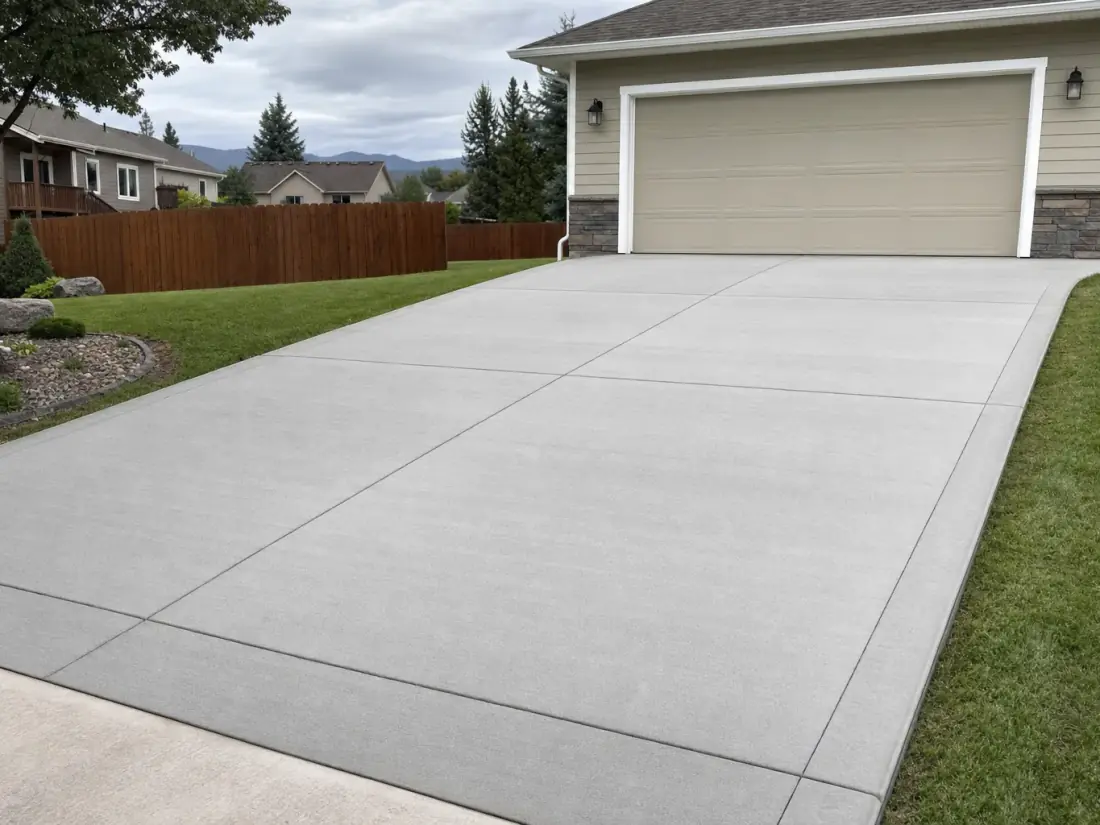
Concrete Driveways in Spokane Valley, WA — What to Expect
A driveway in this climate is a freeze-thaw problem before it is a concrete problem. Water gets into the slab, freezes, expands, and does that a hundred times a winter. Slab thickness, air entrainment in the mix and a properly compacted base are what decide whether it is still flat in fifteen years.
We place driveways on a compacted aggregate base cut to depth, not on whatever subgrade happened to be there. Control joints are cut at spacings matched to the slab thickness so the concrete cracks where we put the joint rather than across the middle of the apron.
Reinforcement is sized to expected loading. A daily commuter car and an RV or loaded work truck are different design problems, and it is worth saying which you have before we quote.
What Is Included
- Compacted aggregate base cut to depth
- Air-entrained mix specified for freeze-thaw
- Control joints cut at correct spacing
- Rebar or mesh reinforcement to expected loading
- Apron and street transition formed correctly
- Broom, smooth or exposed aggregate finish
Our Process for Concrete Driveways
- 1
Step 1: Measure, Layout and Access Check
The driveway is measured and marked, and we work out how the truck reaches the pour. Access decides whether concrete is placed directly, pumped or barrowed, and that changes the price.
- 2
Step 2: Excavation and Subgrade Preparation
Existing surface is removed and the subgrade cut to depth. Soft spots are dug out rather than bridged over, because a slab is only as good as what it sits on.
- 3
Step 3: Base, Forms and Reinforcement
Compacted aggregate base goes in, forms are set to line and fall, and rebar or mesh is placed on chairs so it sits within the slab rather than on the ground.
- 4
Step 4: Pour, Screed and Finish
Concrete is placed, screeded to level, floated and given the specified finish. Timing matters here more than anywhere else in the job.
- 5
Step 5: Joint Cutting and Curing
Control joints are saw-cut within the correct window and the slab is cured properly. Both are what decide whether cracking lands in the joints or across the middle.
Concrete Driveways We Offer in Spokane Valley
Standard Broom Finish Driveways
The default for this climate. Textured enough to stay grippy in ice and rain, and the most economical finish available.
Exposed Aggregate Driveways
The surface mortar washed back to reveal the stone. Excellent grip, hides dirt well, and reads as a step above plain grey.
Reinforced Heavy-Duty Driveways
Thicker slabs with heavier reinforcement for RVs, boats and work trucks. Worth specifying up front rather than discovering the need later.
Driveway Replacement and Removal
Breaking out and disposing of an existing driveway, including dealing with whatever subgrade problems caused the first one to fail.
Why We Are the Concrete Contractor to Call in Spokane Valley, WA
Drainage designed in, not added on
Nearly every failed wall in this region failed because water had nowhere to go. Drainage stone, filter fabric and outlets are part of the design, never an upsell.
We tell you when you need an engineer
Walls over four feet, surcharged walls and tiered walls generally need stamped drawings. We say so up front rather than building something that fails inspection.
Built for freeze-thaw
Inland Northwest winters move soil hard. Base depth, compaction and backfill are specified for frost, not copied from a warm-climate detail.
Written scope before work starts
Wall height, block type, drainage detail, geogrid layout and backfill material, all in writing. You can put it out to competitive bid.
Slope and erosion work, not just walls
Sometimes the right answer is regrading, terracing or planting rather than a taller wall. We will tell you when that is cheaper.
Clean sites, real restoration
Excavation spoil hauled away, access routes protected, and the lawn put back. Wall work is heavy and messy — the cleanup is part of the job.
Concrete Driveways FAQs
How thick should a concrete driveway be?
Four inches is common for cars, but in this climate and for anything heavier a thicker slab with proper reinforcement is the better spend. Slab thickness is one of the few places where saving money reliably costs more later.
How long before I can drive on it?
Foot traffic in a day or so, light vehicles typically after about a week, and heavier vehicles longer. Cold weather extends all of it, since concrete gains strength more slowly as temperatures drop.
Why do driveways crack?
Concrete shrinks as it cures and that movement has to go somewhere. Control joints give it a planned place to crack. Cracking outside the joints usually means joints were cut too late, spaced too widely, or the subgrade moved.
Can I pour concrete in winter here?
Sometimes, with cold-weather measures such as heated blankets and mix adjustments, but it adds cost and risk. Where the job can wait, spring through autumn gives a better slab for less money.
Concrete or asphalt for a driveway?
Concrete lasts longer, handles heat better and needs less ongoing attention. Asphalt costs less initially and tolerates ground movement better. In a freeze-thaw climate concrete usually wins on total cost over its life.
Other Services in Spokane Valley
- Retaining Wall DrainageDrainage design and retrofit — the single most common reason walls in this region fail.
- Poured Concrete Retaining WallsCast-in-place reinforced concrete for high walls, tight property lines and heavy surcharge loads.
- Timber Retaining WallsTreated timber walls for lower-height applications, plus honest advice on when timber is the wrong choice.