Retaining Wall Drainage Problems in Spokane Valley, WA — What to Expect
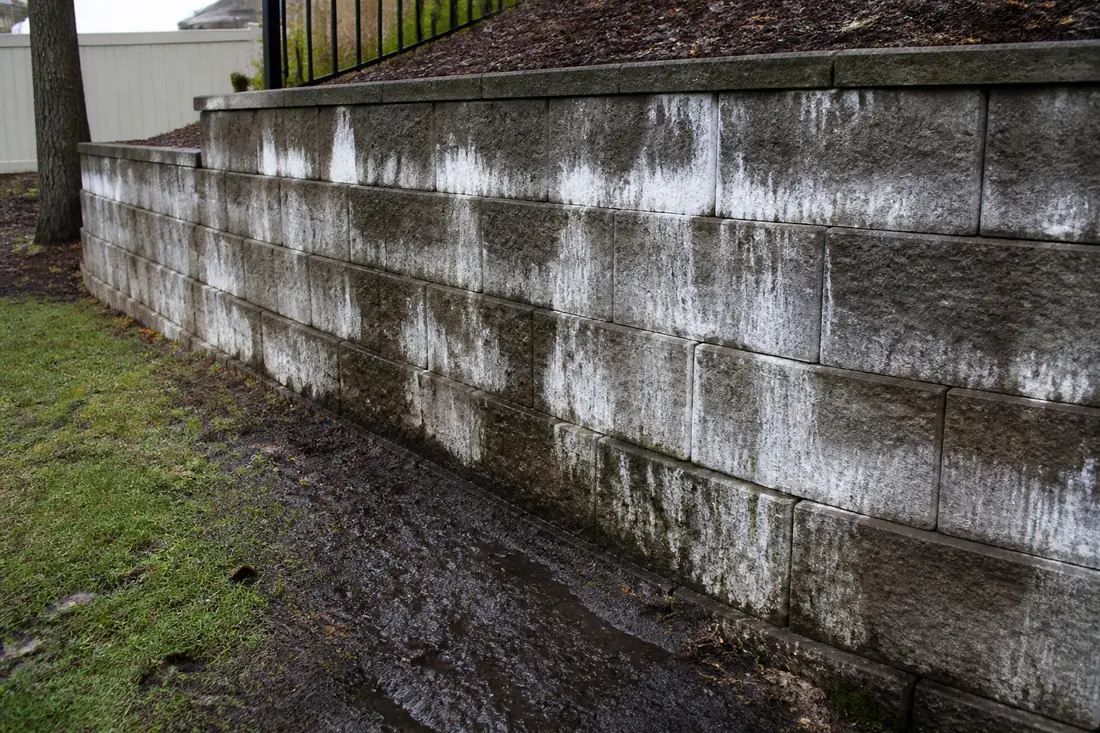
This page is about diagnosing water that is already causing trouble, rather than about installing drainage in a new wall. The symptoms are usually visible from the front: white efflorescence staining bleeding down the face, water seeping between blocks after rain, soil saturated at the base long after the weather has passed, ice forming on the face in winter, or ground above the wall staying soft when the rest of the yard has dried.
Each of those says something slightly different. Efflorescence means water is moving through the wall and carrying dissolved salts with it, which tells you there is water behind the face and it is finding a path through rather than around. Seeping between blocks after rain suggests a drainage route that cannot keep up, or one that has silted up. Saturated soil at the base can mean the collector pipe has no outlet, is crushed, or was never connected to daylight at all.
A working drainage system behind a wall is not complicated. Clean drainage stone against the back of the face, filter fabric between that stone and the retained soil to stop fines migrating in, and a perforated collector pipe at the bottom with a route to somewhere lower than the wall. Most drainage problems come down to one of those four being absent, blocked, or never taken anywhere.
What Is Included
- Symptom read first — efflorescence, seeping, saturation or ice
- Existing drainage route traced, including whether it daylights
- Surface water and roof discharge checked above the wall
- Silted or crushed collector pipe identified rather than assumed
- Retrofit options compared against rebuilding the affected span
- Findings written down before any work is priced
The Retaining Wall Drainage Problems Process
- 1
Step 1: Read the Symptom
Efflorescence, seeping, saturated ground and winter ice each indicate something different about where water is going. The symptom narrows the investigation before anything is dug.
- 2
Step 2: Trace the Route
Whether drainage stone, filter fabric and a collector pipe exist behind the wall, and critically whether that pipe goes anywhere. A collector pipe with no outlet is a common finding and an easy one to miss.
- 3
Step 3: Look Above the Wall
Roof discharge, irrigation, altered grading and surface water concentrating uphill. A large proportion of drainage problems at a wall originate somewhere above it rather than behind it.
- 4
Step 4: Compare Retrofit and Rebuild
Some drainage can be retrofitted from the surface or the ends. Some requires taking the face down. Which applies is established rather than assumed, and both costs are put side by side.
Types of Retaining Wall Drainage Problems in Spokane Valley
Efflorescence and Seepage Diagnosis
Establishing why water is moving through the wall face and where it is entering.
Blocked or Silted Drain Repair
Collector pipes that have silted up, been crushed, or lost their outlet, restored or replaced.
Drainage Retrofit
Installing a working drainage route behind a wall that was built without one.
Surface Water and Roof Discharge Correction
Redirecting the water arriving above the wall, which is often cheaper than anything done behind it.
What Matters When Choosing a Retaining Walls Contractor in Spokane Valley, WA
Drainage designed in, not added on
Poor drainage is one of the most common causes of retaining wall problems in this region. Drainage stone, filter fabric and outlets are part of the design, never an upsell.
We tell you when you need an engineer
Spokane Valley requires an engineered design for walls four feet or higher measured from the bottom of the footing — not from the exposed face — and underdrains on the same basis. Surcharged and tiered walls bring it on sooner. Worth establishing before a design is paid for rather than at plan review.
Built for freeze-thaw
Inland Northwest winters move soil hard. Base depth, compaction and backfill are specified for frost, not copied from a warm-climate detail.
Written scope before work starts
Wall height, block type, drainage detail, geogrid layout and backfill material, all in writing. You can put it out to competitive bid.
Slope and erosion work, not just walls
Sometimes the right answer is regrading, terracing or planting rather than a taller wall. We will tell you when that is cheaper.
Clean sites, real restoration
Excavation spoil hauled away, access routes protected, and the lawn put back. Wall work is heavy and messy — the cleanup is part of the job.
Retaining Wall Drainage Problems FAQs
What is the white staining on my retaining wall?
That is efflorescence — dissolved salts left behind as water moves through the masonry and evaporates at the face. It is not damaging in itself, but it is evidence that water is passing through the wall rather than draining around it, which is worth understanding before it becomes a pressure problem.
Water comes through my wall after it rains. Is that normal?
Some weeping through the joints of a boulder or dry-laid wall is expected, because those walls drain through the face by design. Water seeping through a segmental or poured wall after rain generally means the drainage behind it cannot keep up, has silted up, or was never installed.
Do retaining walls need drainage?
In practice, yes for any wall retaining soil that can become saturated. Water accumulating behind a wall adds substantial pressure that the wall was not designed to carry. A working system is drainage stone behind the face, filter fabric keeping soil fines out of that stone, and a perforated pipe with a route to daylight.
Can drainage be added to an existing wall?
Sometimes, and how invasively depends on the wall. Surface water and roof discharge above the wall can often be corrected without touching it. Adding a proper drainage zone behind the face usually means taking at least part of the wall down, and at that point the cost is compared against rebuilding that span.
Why is the ground at the base of my wall always wet?
Commonly because the collector pipe behind the wall has no outlet, has been crushed, or has silted up, so water reaching the base has nowhere to go. It can also mean there was never a collector pipe at all. Tracing whether the drain daylights anywhere is usually the quickest way to find out.
Other Services in Spokane Valley
- Concrete SealingSealing that keeps water and de-icing salt out of the slab, which is most of what decides whether concrete survives an Inland Northwest winter.
- Concrete Levelling and Slab LiftingSettled slabs raised back to level by injection, for a fraction of the cost of breaking out and repouring.
- Stamped and Decorative ConcreteStamped, stained and colored concrete that gets the look of stone or paver without the joints and the weeds.