Boulder and Rock Retaining Walls in Spokane Valley, WA — What to Expect
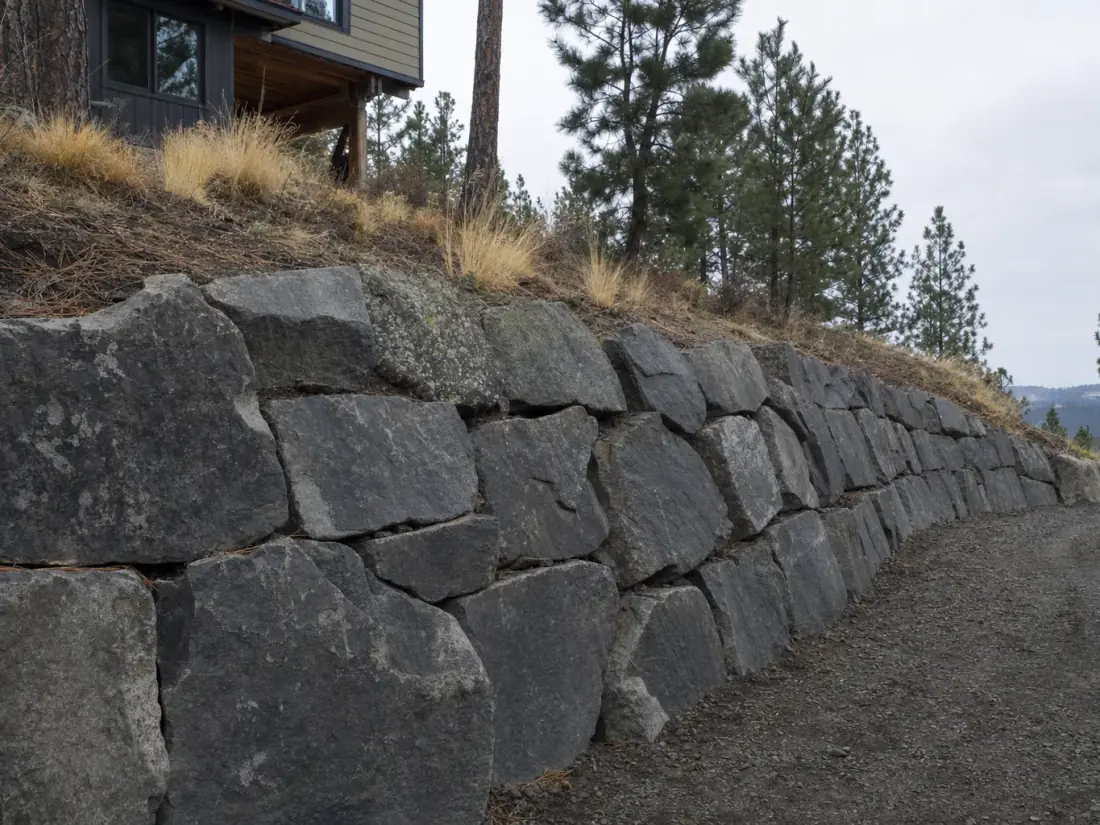
Boulder walls suit this region. The material is locally available, the look belongs in the landscape, and a well-built boulder wall handles the irregular grades common on Spokane-area lots better than a rigid system.
The engineering is different from block. Stability comes from mass and from how the stones key into each other, which means placement is a skilled operation rather than stacking. Batter into the slope matters more, not less.
Drainage still governs. A boulder wall has more natural voids than block, but the backfill behind it still needs to drain or it will push the face out over time.
What Is Included
- Locally sourced basalt and granite
- Each stone placed and keyed, not dumped
- Batter set into the slope for stability
- Drainage and filter fabric behind the face
- Suits irregular grades and curved layouts
The Boulder and Rock Retaining Walls Process
- 1
Step 1: Stone Selection and Sourcing
Boulder size is matched to wall height and to what the site access will allow. Locally sourced basalt and granite suit the setting and keep haulage cost down.
- 2
Step 2: Excavation and Keyed Base
The base is excavated and the first course of stone set below finished grade, keyed into undisturbed soil so the wall has something to work against.
- 3
Step 3: Stone Placement and Keying
Each stone is placed and turned by machine until it beds against its neighbors. This is the skilled part of a boulder wall and it is what separates a structure from a pile.
- 4
Step 4: Batter and Backfill
The face is built with a pronounced backward lean into the slope, and drainage stone and compacted backfill go in behind as the wall rises.
- 5
Step 5: Chinking, Grading and Planting
Smaller stone fills the visible voids, final grading moves water away, and planting pockets can be left where you want the wall to soften over time.
Types of Boulder and Rock Retaining Walls in Spokane Valley
Basalt Boulder Walls
The regional default. Dark, angular and heavy, it keys together well and looks native to the Inland Northwest landscape.
Granite and Mixed Stone Walls
Lighter tones and rounder forms, chosen where the wall is a landscape feature and the color matters as much as the structure.
Terraced Boulder Walls
Multiple boulder tiers stepping up a slope with planted benches between, generally cheaper than one very tall boulder wall.
Erosion Control Rock Placement
Loose rock armoring on slopes and swales where the objective is holding soil against running water rather than creating level ground.
What Matters When Choosing a Retaining Walls Contractor in Spokane Valley, WA
Drainage designed in, not added on
Poor drainage is one of the most common causes of retaining wall problems in this region. Drainage stone, filter fabric and outlets are part of the design, never an upsell.
We tell you when you need an engineer
Spokane Valley requires an engineered design for walls four feet or higher measured from the bottom of the footing — not from the exposed face — and underdrains on the same basis. Surcharged and tiered walls bring it on sooner. Worth establishing before a design is paid for rather than at plan review.
Built for freeze-thaw
Inland Northwest winters move soil hard. Base depth, compaction and backfill are specified for frost, not copied from a warm-climate detail.
Written scope before work starts
Wall height, block type, drainage detail, geogrid layout and backfill material, all in writing. You can put it out to competitive bid.
Slope and erosion work, not just walls
Sometimes the right answer is regrading, terracing or planting rather than a taller wall. We will tell you when that is cheaper.
Clean sites, real restoration
Excavation spoil hauled away, access routes protected, and the lawn put back. Wall work is heavy and messy — the cleanup is part of the job.
Boulder and Rock Retaining Walls FAQs
Are boulder walls cheaper than block?
Often slightly, particularly at lower heights where stone can be sourced locally and machine placement is quick. The comparison narrows as walls get taller because the stone has to get bigger and the machinery larger.
How tall can a boulder wall be?
Lower than people expect for a single tier. Stability comes from mass and batter, so height is limited by stone size and how far you can lean the face back. Taller requirements are usually met by terracing rather than one big wall.
Do boulder walls need drainage?
The wall face itself drains freely through the joints, which helps, but the soil behind it still needs a route out. On anything structural the same drainage stone and collector pipe belong behind it as behind block.
Will the stones shift over time?
Properly keyed stone settles slightly in the first season and then stays put. Movement beyond that usually means the base was not keyed into undisturbed soil or water is undermining the toe.
Can I plant in a boulder wall?
Yes, and it looks good. Planting pockets can be left deliberately during the build and filled with soil. It is much easier to plan them in than to retrofit them afterwards.
Other Services in Spokane Valley
- Paver Patios and WalkwaysInterlocking paver patios and paths laid on a proper compacted base so they stay flat and keep draining.
- Concrete SealingSealing that keeps water and de-icing salt out of the slab, which is most of what decides whether concrete survives an Inland Northwest winter.
- Gabion Retaining WallsWire basket walls filled with rock — free-draining by construction, tolerant of movement, and suited to slopes and watercourses.