Retaining Wall Drainage in Spokane Valley, WA — What to Expect
Saturated soil weighs far more than dry soil and exerts hydrostatic pressure a wall was probably never designed to resist. That is the mechanism behind most wall failures we are called to look at.
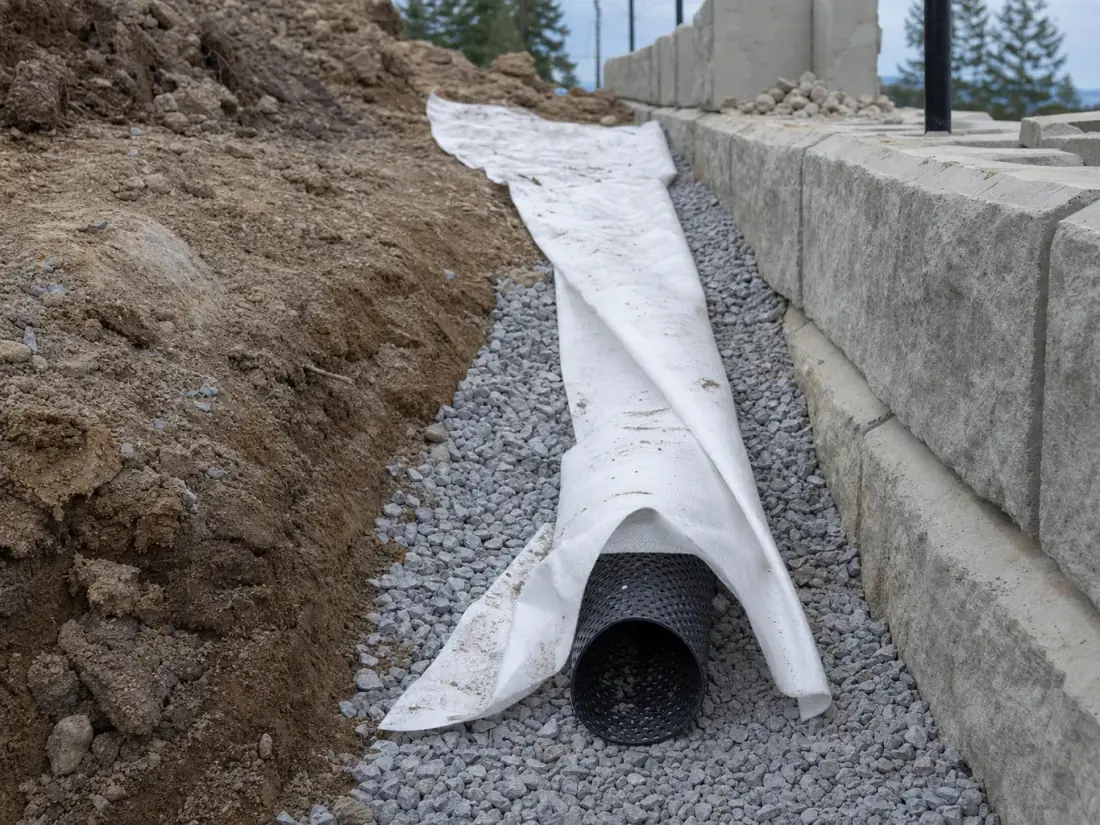
A working drainage system is a stone zone behind the wall face, filter fabric keeping fines out of that stone, a perforated collector pipe at the base, and an outlet that actually daylights somewhere useful. Miss any one of those and the system does not work.
On existing walls we can often retrofit drainage without a full rebuild, which is dramatically cheaper than replacement and frequently stops the movement.
What Is Included
- Drainage stone zone and filter fabric
- Perforated collector pipe with positive fall
- Outlets daylighted or tied to storm drainage
- Retrofit into existing walls without full rebuild
- Surface grading corrected above the wall
Our Process for Retaining Wall Drainage
- 1
Step 1: Water Source Investigation
We establish where the water is actually coming from: surface run-off, roof discharge, a spring line, irrigation, or groundwater. The fix depends entirely on the answer.
- 2
Step 2: Excavation Behind the Wall Face
The backfill is opened up behind the affected section so the drainage components can be installed against the wall rather than somewhere vaguely near it.
- 3
Step 3: Stone Zone and Filter Fabric
A clean drainage stone zone is placed against the wall face and wrapped in filter fabric, which is what stops soil fines washing in and clogging it within a few seasons.
- 4
Step 4: Collector Pipe and Outlet
Perforated pipe is laid at the base with positive fall to an outlet that genuinely daylights or ties into a system able to take it.
- 5
Step 5: Backfill and Surface Grading
Compacted backfill goes back in and the surface above is graded so water runs away from the wall rather than straight down into the drainage you just installed.
Retaining Wall Drainage We Offer in Spokane Valley
New Wall Drainage Systems
Drainage designed and installed as part of a new wall, which is the only time it is straightforward and inexpensive.
Retrofit Drainage on Existing Walls
Installing drainage into a wall that never had it, without a full rebuild. Frequently arrests movement for a fraction of replacement cost.
Surface Water Diversion
Swales, regrading and downspout extension intercepting water above the wall before it ever reaches the backfill.
Outlet and Discharge Solutions
Getting collected water somewhere legitimate, whether by daylighting, tying into storm drainage, or a dry well where nothing else is available.
Why We Are the Retaining Walls Contractor to Call in Spokane Valley, WA
Drainage designed in, not added on
Nearly every failed wall in this region failed because water had nowhere to go. Drainage stone, filter fabric and outlets are part of the design, never an upsell.
We tell you when you need an engineer
Walls over four feet, surcharged walls and tiered walls generally need stamped drawings. We say so up front rather than building something that fails inspection.
Built for freeze-thaw
Inland Northwest winters move soil hard. Base depth, compaction and backfill are specified for frost, not copied from a warm-climate detail.
Written scope before work starts
Wall height, block type, drainage detail, geogrid layout and backfill material, all in writing. You can put it out to competitive bid.
Slope and erosion work, not just walls
Sometimes the right answer is regrading, terracing or planting rather than a taller wall. We will tell you when that is cheaper.
Clean sites, real restoration
Excavation spoil hauled away, access routes protected, and the lawn put back. Wall work is heavy and messy — the cleanup is part of the job.
Retaining Wall Drainage FAQs
How do I know if my wall has drainage?
Look for an outlet. A working system has a pipe end daylighting somewhere below or beside the wall, and after heavy rain it should actually run. No visible outlet usually means no system, or one that was never connected to anything.
Can drainage be added without rebuilding the wall?
Often yes. We excavate the backfill behind the wall face and install the stone zone, fabric, pipe and outlet, then reinstate. It is a fraction of rebuild cost and on many walls it stops the movement.
What are weep holes and are they enough?
Weep holes let water that has already reached the wall face escape through it. They help, but on their own they do not drain the soil mass behind the wall, which is what generates the pressure. They are part of a system, not a substitute for one.
Where should the water go?
Somewhere it can leave without creating a new problem. Daylighting downslope is simplest. Tying into storm drainage may need permission. Discharging onto a neighbouring property is not an option, so we establish the outfall before designing the collection.
Does landscape fabric work as filter fabric?
No. Landscape fabric is designed to suppress weeds and clogs quickly when soil fines wash against it. Drainage filter fabric is specified for flow and particle retention, and substituting one for the other is a common and expensive shortcut.
Other Services in Spokane Valley
- Outdoor Steps and StairwaysStone, block and paver stairways connecting terraced levels on sloped Inland Northwest lots.
- Drainage and GradingYard drainage, French drains and regrading that move water away from walls, patios and foundations.
- Retaining Wall RepairLeaning, bulging and cracked walls diagnosed and repaired — starting with why it moved.