Block and Segmental Retaining Walls in Spokane Valley, WA — What to Expect
Segmental retaining block is the default choice for most residential walls: it is quick to build, tolerates minor settlement, and comes in finishes that suit a garden as easily as a driveway edge.
It is also the system most often installed badly, because the blocks stack so easily that the parts that matter get skipped. A block wall with no drainage stone, no filter fabric and no geogrid will look perfect for two winters and then start leaning.
We build to the block manufacturer specification for the height involved, which is also what an inspector will look for if the wall is permitted.
What Is Included
- Manufacturer-specified base and setback
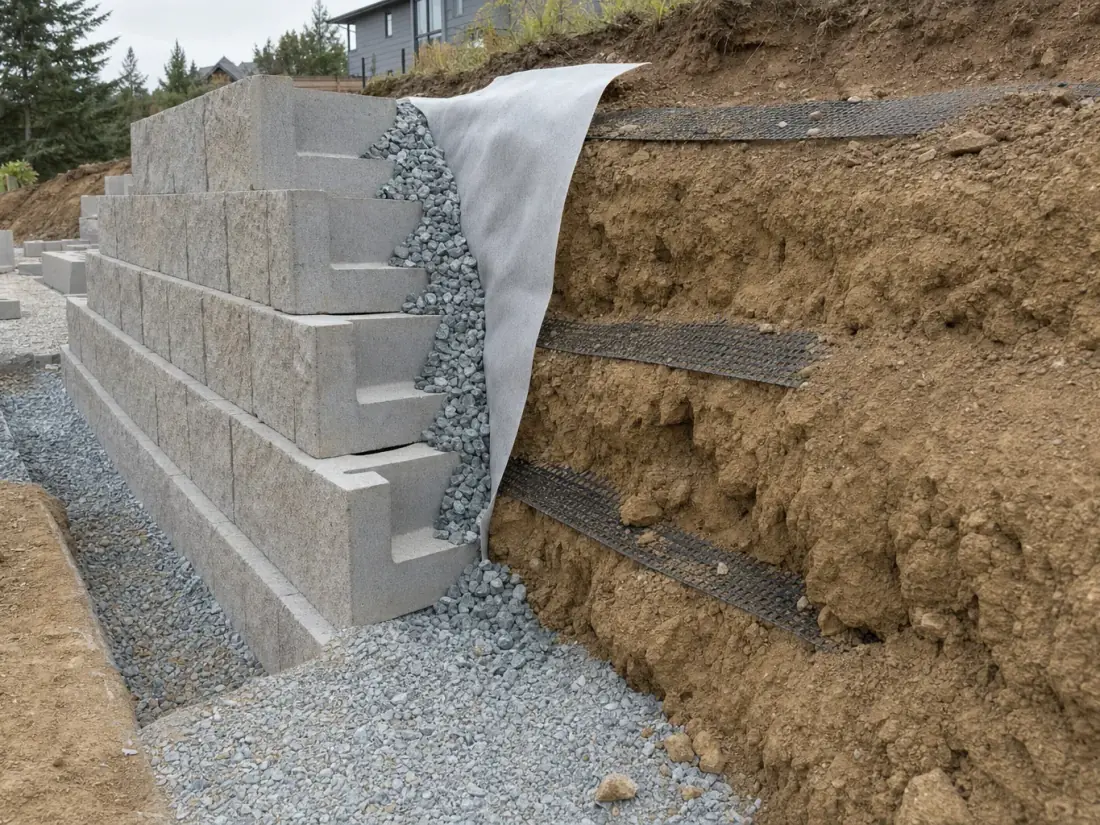
- Drainage stone zone and filter fabric behind the face
- Geogrid layers at specified vertical spacing
- Compaction in lifts, not all at once
- Cap course adhered and levelled
Our Process for Block and Segmental Retaining Walls
- 1
Step 1: Block Selection and Layout
Unit type is chosen for the wall height and the look you want, and the run is set out on the ground including any curves and corners so cutting can be planned.
- 2
Step 2: Base Trench and Compaction
Trench excavated to the manufacturer specified depth for that block and height, then aggregate placed and compacted in lifts to a firm, level bed.
- 3
Step 3: Base Course Setting
The first course is levelled in both directions along the whole run. This is the slowest part of the build and it determines everything above it.
- 4
Step 4: Stacking with Setback and Reinforcement
Courses are laid with the block manufacturer setback, drainage stone and filter fabric placed behind the face, and geogrid installed at the specified vertical spacing.
- 5
Step 5: Capping and Finishing
Cap units are cut where needed, adhered and levelled, and the area behind the wall is graded so surface water runs away rather than into the backfill.
Block and Segmental Retaining Walls We Offer in Spokane Valley
Standard Gravity Block Walls
Walls low enough to stand on their own mass without soil reinforcement. Fast to build and appropriate for most garden-scale work.
Geogrid Reinforced Block Walls
Taller walls tied back into the hillside with horizontal geogrid layers. This is what allows block systems to go well above gravity height safely.
Large Format Block Walls
Heavier units used for taller or commercial walls, placed by machine. Fewer joints, faster on long runs, and a more industrial appearance.
Decorative and Textured Block
Split-face, tumbled and multi-piece systems chosen where the wall is a visible feature rather than purely structural.
Why We Are the Retaining Walls Contractor to Call in Spokane Valley, WA
Drainage designed in, not added on
Nearly every failed wall in this region failed because water had nowhere to go. Drainage stone, filter fabric and outlets are part of the design, never an upsell.
We tell you when you need an engineer
Walls over four feet, surcharged walls and tiered walls generally need stamped drawings. We say so up front rather than building something that fails inspection.
Built for freeze-thaw
Inland Northwest winters move soil hard. Base depth, compaction and backfill are specified for frost, not copied from a warm-climate detail.
Written scope before work starts
Wall height, block type, drainage detail, geogrid layout and backfill material, all in writing. You can put it out to competitive bid.
Slope and erosion work, not just walls
Sometimes the right answer is regrading, terracing or planting rather than a taller wall. We will tell you when that is cheaper.
Clean sites, real restoration
Excavation spoil hauled away, access routes protected, and the lawn put back. Wall work is heavy and messy — the cleanup is part of the job.
Block and Segmental Retaining Walls FAQs
How high can a block wall go without engineering?
Roughly four feet of exposed face is the common threshold, but it drops if there is a surcharge above the wall or a slope below it. Manufacturer tables give gravity heights for their own units, and above that reinforcement is required regardless of the permit position.
What is setback and why does it matter?
Setback is the small backward step built into each course, giving the wall a slight lean into the slope. It is designed into the block geometry and it is what puts the wall mass to work resisting the soil rather than fighting it.
Do block walls need drainage if the block has gaps?
Yes. The gaps between units let some water through but they do not drain the soil mass behind the wall. Without a stone drainage zone and a collector pipe, saturated backfill still generates pressure the wall was not designed for.
What is the gravel behind the wall for?
It gives water a path to travel down and out rather than sitting in the soil against the wall face. Filter fabric keeps soil fines from washing into that stone and clogging it, which is why the fabric matters as much as the stone.
Will the wall need maintenance?
Very little. Keep the drainage outlet clear, keep surface water from pooling above the wall, and reset a cap if one comes loose. Anything beyond that usually indicates a drainage problem worth looking at.
Other Services in Spokane Valley
- Drainage and GradingYard drainage, French drains and regrading that move water away from walls, patios and foundations.
- Outdoor Steps and StairwaysStone, block and paver stairways connecting terraced levels on sloped Inland Northwest lots.
- Fire Pits and Seating WallsBuilt-in fire pits, seating walls and outdoor kitchens that turn a patio into a space people actually use.