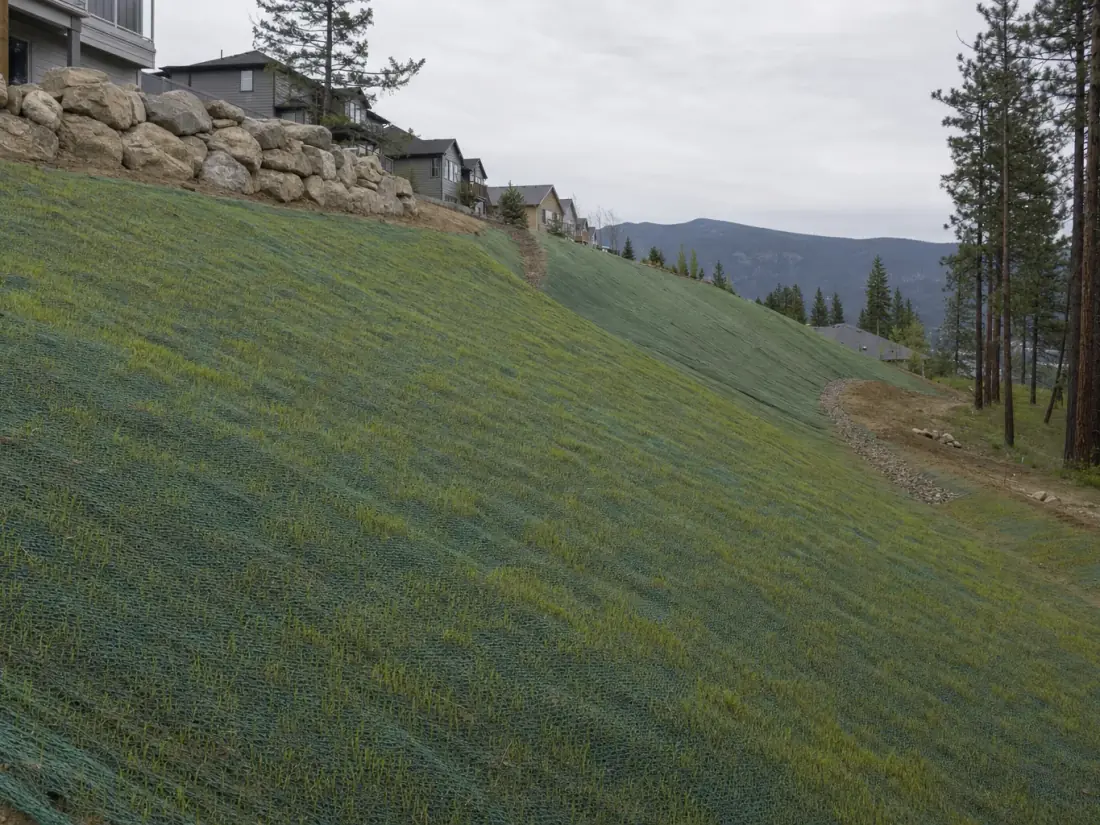
Erosion Control and Slope Stabilization in Spokane Valley, WA — What to Expect
Not every slope problem needs a retaining wall. Regrading to a stable angle, terracing, erosion blanket and planting will sometimes solve it for a fraction of the cost, and on a large slope that is frequently the better engineering answer.
Where a wall is needed, it usually works alongside slope treatment rather than instead of it. Water arriving at the top of a wall is a wall problem waiting to happen.
We assess the slope, identify whether the movement is surface erosion or deeper instability, and price the options honestly — including the ones that do not involve building a wall.
What Is Included
- Slope assessment before recommending a solution
- Regrading to a stable angle where feasible
- Erosion control blanket and revegetation
- Surface water intercepted above the slope
- Wall and slope treatment combined where required
Our Process for Erosion Control and Slope Stabilization
- 1
Step 1: Slope Assessment
We establish whether you are dealing with surface erosion or deeper instability, because they need completely different answers and the visible symptom looks similar.
- 2
Step 2: Water Management Design
Surface water is intercepted above the slope first. Treating a slope while water keeps arriving at the top of it is work that gets undone.
- 3
Step 3: Regrading and Contouring
Where feasible the slope is cut back to a stable angle or contoured into benches, which is often cheaper and more durable than building a structure.
- 4
Step 4: Stabilisation Measures
Erosion blanket, matting, live staking or rock armouring is installed according to slope angle, soil and how much water crosses it.
- 5
Step 5: Revegetation and Monitoring
Seeding or planting establishes root structure, which is what holds the surface long term. We tell you what the first two seasons should look like.
Erosion Control and Slope Stabilization We Offer in Spokane Valley
Surface Erosion Control
Blanket, matting and revegetation for slopes losing topsoil to run-off but otherwise stable.
Slope Regrading and Benching
Cutting a slope back to a stable angle or stepping it into benches, frequently the most economical fix on a large area.
Rock Armouring and Riprap
Loose stone protecting slopes and channels where concentrated water flow is the erosive force.
Combined Wall and Slope Treatment
A retaining wall at the toe with slope treatment above, used where a wall alone would simply be undermined from behind.
Why We Are the Retaining Walls Contractor to Call in Spokane Valley, WA
Drainage designed in, not added on
Nearly every failed wall in this region failed because water had nowhere to go. Drainage stone, filter fabric and outlets are part of the design, never an upsell.
We tell you when you need an engineer
Walls over four feet, surcharged walls and tiered walls generally need stamped drawings. We say so up front rather than building something that fails inspection.
Built for freeze-thaw
Inland Northwest winters move soil hard. Base depth, compaction and backfill are specified for frost, not copied from a warm-climate detail.
Written scope before work starts
Wall height, block type, drainage detail, geogrid layout and backfill material, all in writing. You can put it out to competitive bid.
Slope and erosion work, not just walls
Sometimes the right answer is regrading, terracing or planting rather than a taller wall. We will tell you when that is cheaper.
Clean sites, real restoration
Excavation spoil hauled away, access routes protected, and the lawn put back. Wall work is heavy and messy — the cleanup is part of the job.
Erosion Control and Slope Stabilization FAQs
Do I need a wall or will regrading fix it?
It depends on how much level ground you need and how steep the slope is. If the objective is stopping soil loss rather than creating usable space, regrading and planting is often cheaper and more durable. We price both honestly.
How fast does erosion control work?
Blanket and matting protect immediately. The vegetation that provides the long-term hold takes a full growing season to establish, and the first winter is the vulnerable one, which is why timing the work matters.
What causes a slope to start moving?
Almost always a change in water. A new roof discharge, altered grading uphill, a broken irrigation line or an unusually wet season adds water to soil that was previously stable, and the slope finds a new angle.
Can I just plant it and hope?
On a gentle slope with minor surface loss, sometimes. On anything steep or already moving, planting alone will not establish before the next rain event removes it, which is what the blanket or matting is there to prevent.
Is slope work covered by insurance?
Generally not. Gradual erosion and earth movement are standard exclusions on most homeowner policies. Sudden collapse caused by a covered event is occasionally treated differently, and it is worth reading the policy rather than assuming either way.
Other Services in Spokane Valley
- Drainage and GradingYard drainage, French drains and regrading that move water away from walls, patios and foundations.
- Outdoor Steps and StairwaysStone, block and paver stairways connecting terraced levels on sloped Inland Northwest lots.
- Concrete DrivewaysPoured concrete driveways built with the base depth, thickness and control joints Inland Northwest freeze-thaw demands.